Search Engine Submission - AddMe Red Palm Weevils

Tuesday, 17 May 2011

Treatment to prevent infestation


Given the characteristics and nature of an infestation by red palm weevils it is vital that it is rapidly detected. To get a reliable diagnosis of the condition of a palm, a specialist company or qualified professional should be consulted. They will be able to advise on treatments or methods of prevention .
There are only some chemical products licensed for preventative and curative treatments, which can be used on their own, combined with or alternating with biological treatments using entomological pathogenic nematodes.
Recommended intervals between treatments are 4 - 6 weeks.
Junta de Andalucia information
Integrated pest management involves a number of strategies to prevent infestation, such as combination treatments and using pheromone traps. Trials in Finca La Concepcion (Malaga) and Finca El Batatal (Marbella) have achieved excellent success in saving infested palms (93%) and there have been very few further cases of infestation.
More information about using traps can be found from Econex (Spanish but click on flag for translation)

Sunday, 8 May 2011

What are the signs of an infested palm?

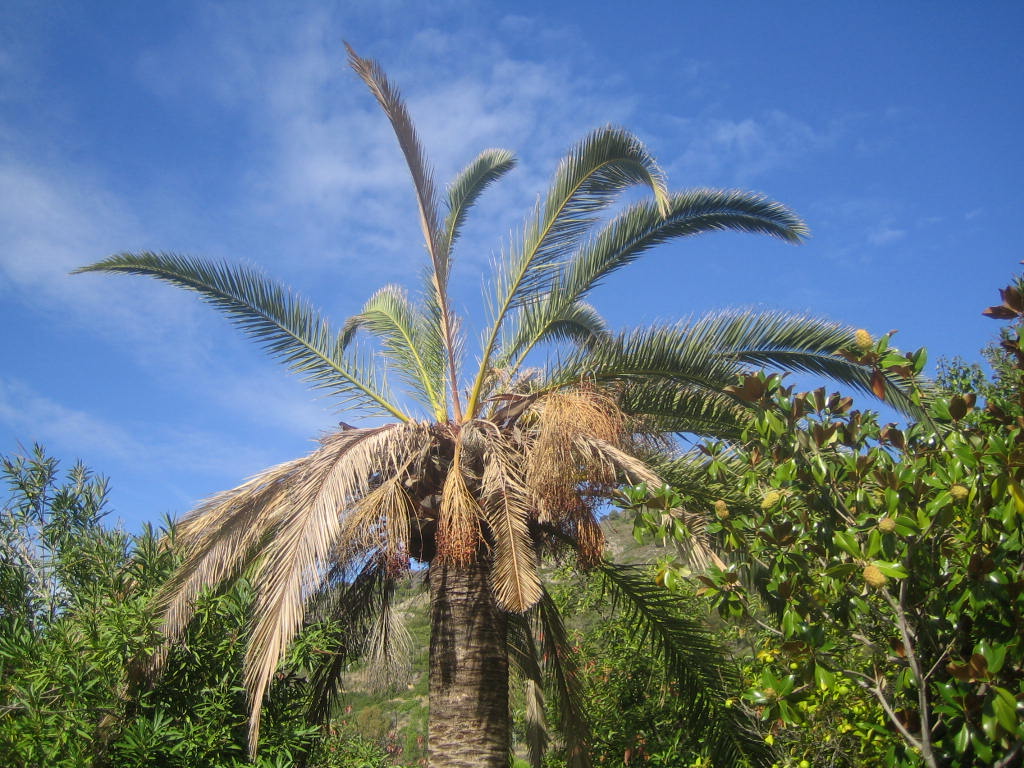
Symptoms include holes in leaves, leaves that appear to be cut in a straight line with scissors, drooping leaf or leaves, dry leaf or leaves, vinegar smell, cocoons in trunk or wedged between leaves, old cocoons on the floor or you may just see lots of weevils flying around - they are attracted by other weevils.


Monday, 25 April 2011

Marbella Palm with Two Crowns

Last week I came across this wonderful palm. Usually a palm only has ONE region of growth (apical meristematic tissue) resulting in just one crown of leaves but this one must have suffered some damage, possibly by the red palm weevil larvae, resulting in a division of the region actively carrying out cell division.

Thursday, 14 April 2011

Surviving Red Palm Weevil Attack

A badly infested Phoenix canariensis was treated with systemic and contact insecticides last November. The damage was right in the crown with cocoons emerging from the new growing leaves and a large section was rotten, smelling characteristically of vinegar. Several months on a new leaf, albeit eaten, has emerged on the less damaged side of the palm giving hope of recovery.

Tuesday, 5 April 2011

List of palms affected by the Red Palm Weevil

Rhynchophorus ferrugineus has had an enormous impact on the landscapes of the Mediterranean Coast. The most obvious victims are the mature Canary Palms (Phoenix caneriensis). Although the preference or indeed detrimental effects are mainly observed on this species, many palms are susceptible and with infestation can also result in death of the palm. The list below details all palms that have been host to the Red Palm Weevil.
· Areca catechu
· Arenga saccharifera
· Arenga pinnata
· Borassus fl abellifer
· Borassus sp.
· Calamus merrillii
· Caryota cumingii
· Caryota maxima
· Cocos nucifera
· Corypha utan (= C. gebanga, C. elata)
· Corypha umbraculifer
· Elaeis guineensis
· Livistona decipiens
· Livistona chinensis
· Livistona saribus (= Livistona cochinchinensis)
· Livistona subglobosa
· Metroxylon sagu
· Oneosperma horrida
· Oneosperma tigillarium
· Phoenix canariensis
· Phoenix dactylifera
· Phoenix sylvestris
· Oreodoxaregia
· Sabal umbraculifera
· Trachycarpus fortunei
· Washingtonia sp.
Also;
· Saccharum officinarum, sugar cane
· Agave americana, century plant
There is some evidence suggesting that the native Chamaerops humilis and the popular Washingtonia filifera demonstrate natural resistance to infestation by the Red Palm Weevil

Tuesday, 29 March 2011

More red palm weevils in spring and autumn

A few dedicated weevil trappers in Alhaurin el Grande and Cartama have been collecting data for over a year.  Here are the results for our catches in 2010.  It is interesting to note that during the hotter months of July and August  and the colder month of January the number of weevils trapped was lower than the milder months in Spring and Autumn. December was particularly mild which could explain the high numbers caught so late in the year.
These figures are a good indication of the number of weevils in flight and in search of new palms to infest throughout the year and it will be interesting to see this years results for a comparison.  In my own personal trap the figures are already higher than last year(we trapped 90 in January), and as we observe so many  deceased palms, everything suggests that this pest is approaching epidemic proportions!

Saturday, 26 March 2011

Red Palm Weevil larvae eat the entire trunk of old Canary Palm!

An article last week shows just how cryptic these insects are!  The palm looked well and healthy but the inside of the trunk was totally hollow. Read about it on this great gardening site: Gardening in Spain.
wordpress web hosting